
Ohio Nonprofits: Your Volunteers May Soon Need Proof of Their Hours
Nov 14, 2026
If your organization works with volunteers, some of them may soon ask you to confirm the hours they served. From January 1, 2027, many adults on Medicaid in Ohio must show 80 hours a month of work or another qualifying activity to keep their coverage, and volunteering counts toward those hours. SNAP, the food assistance program, has had a similar rule for years, and the same law applies it to more adults.
Both changes come from H.R. 1, the federal law known as the One Big Beautiful Bill Act, signed on July 4, 2025. The state decides who keeps their coverage or benefits. What a volunteer may need from you is a record of the hours they served with you.
Who the Medicaid rule covers in Ohio
Ohio’s rule covers adults aged 19 through 64 who have Medicaid because their income is at or below 138% of the federal poverty level, the group Ohio calls Group VIII. It doesn’t affect people who have Medicaid for another reason, people with certain health conditions or people who meet one of the other exemptions.
Each month, a person can meet the 80 hours with paid work, volunteering, a work program, school at least half-time or any mix of them. Ohio counts volunteer work done through an organization, a government agency or a religious group that helps the community, as long as it isn’t for a political purpose. The federal rule adds that the organization oversees the work and keeps track of what was done, on which dates, for how many hours and who can confirm it.
Ohio will also renew Medicaid every six months instead of every twelve. At each renewal, a person shows that they met the requirement in at least one month since their last application or renewal.
What SNAP asks for
SNAP has long required some adults to work or volunteer 80 hours a month, or 20 hours a week, to receive benefits for more than three months in three years. H.R. 1 raised the age limit for that rule from 54 to 64, and it now also covers parents whose youngest child is 14 or older.
In Ohio, volunteer hours for SNAP are confirmed on form JFS 07410, ABA Verification of Unpaid Hours. The volunteer fills in section 1, and your organization fills in sections 2 and 3, with the weekly schedule, and signs. The volunteer then returns the form to the county Job and Family Services office. Ohio asks for it when someone applies, when they renew and when their volunteer work changes.
What Ohio Medicaid asks your organization for
Ohio Medicaid first checks the data it already has. If that doesn’t confirm someone’s hours, it asks them for more information. For volunteering, the state’s guide for partner organizations lists a letter from the organization that gives the person’s scheduled hours and the date they started. The volunteer uploads the letter to Ohio’s Benefits Self-Service Portal, or mails it or takes it to the county Job and Family Services office.
Most states have no form yet
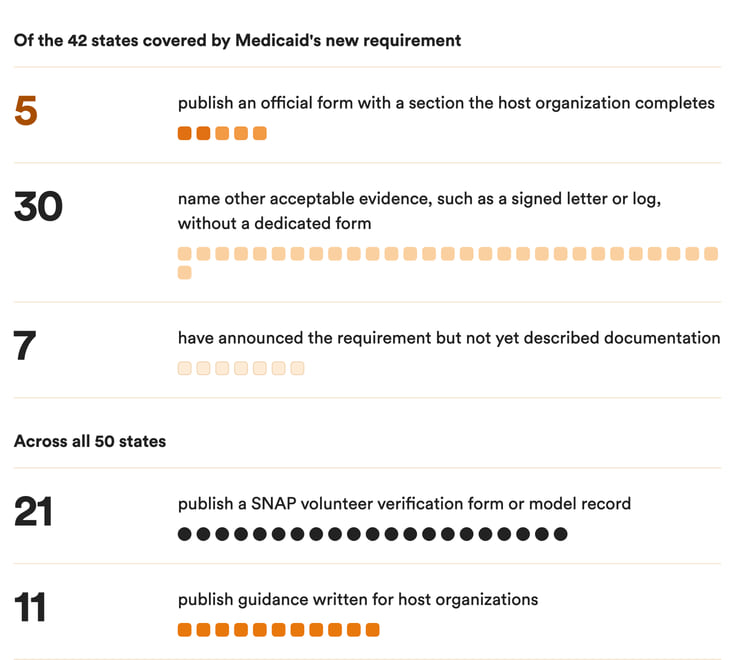
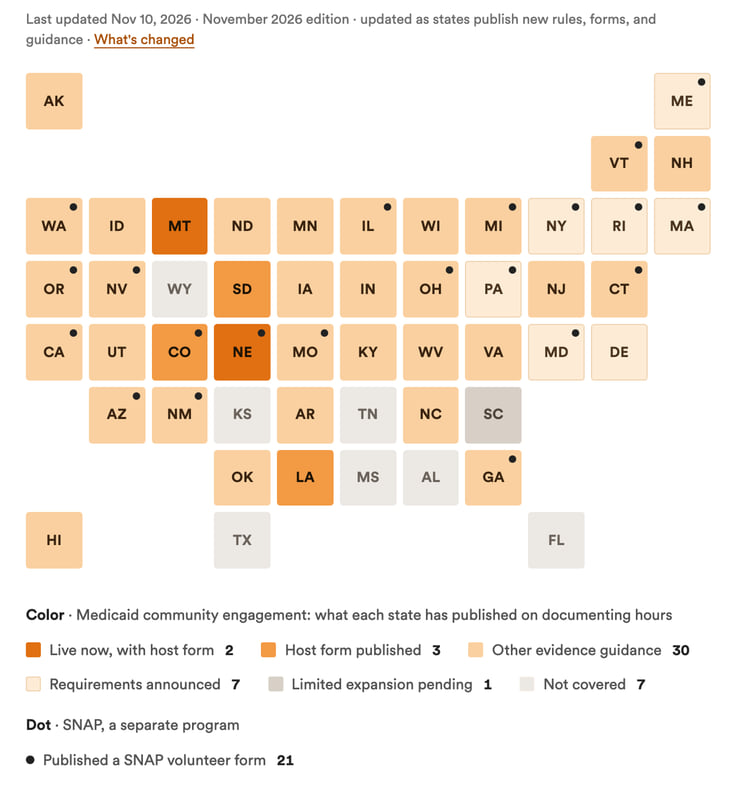
Each state sets its own process, and most haven’t finished. The H.R. 1 Resource Center, which we describe below, counts 42 states where the Medicaid requirement applies. On November 10, 2026, only 5 of them had published a form for the organizations where people volunteer. Ohio has its SNAP form but no Medicaid form, so for Medicaid a letter on your letterhead is the record to give.
Key dates
The Medicaid dates come from the rule the Centers for Medicare & Medicaid Services published on June 3, 2026 to put the law into effect.
- On January 1, 2027, the Medicaid requirement starts in Ohio and in most of the other states it covers. A state that shows it is making a good-faith effort can get a federal exemption, which must end by December 31, 2028.
- Until December 31, 2027, when a state’s data can’t confirm someone’s hours, it may accept other information in place of documents, such as the person’s own statement. A state may also ask for documents before then.
- From January 1, 2028, a state must ask for documents when its data can’t confirm the hours and documents are reasonably available. It must still accept other information when they aren’t. Expect more requests to reach nonprofits from that date.
What to do now
- Record who volunteered on every shift, on which date, for how many hours and what they did. A sign-in sheet works, but a digital record is easier to search when a request comes months later.
- Choose one person to confirm hours and sign letters and forms, and a second person for when they are away. The federal rule expects a contact at your organization who can confirm the hours.
- Write the letter once and fill it in for each request. Give the volunteer’s full name, your organization’s name and address, the program, the dates and hours served, what the volunteer did, and the name and phone number or email address of the person who can confirm it, then sign and date it. The federal rule lists most of these details as the ones that support a state’s decision. For Ohio Medicaid, include the volunteer’s scheduled hours and the date they started.
- Keep a copy of form JFS 07410 for SNAP requests in Ohio. If you work in other states, look up what each one accepts.
- Keep welcoming volunteers. Nothing in the law changes who can volunteer with you, but it makes your records matter more.
A free resource for every state
POINT built the H.R. 1 Resource Center, a free site that tracks the Medicaid and SNAP volunteer rules in all 50 states. It has a page for each state with links to the official sources, a library of the official state forms, a timeline of the federal and state dates, and plain-language guides for nonprofits, among them what counts as proof of volunteer hours.
If you’re in Ohio, start with the Ohio page. It gives Ohio’s start date, what the state has published on verification and the official SNAP form. The site is updated as states publish new rules, and you can sign up there for an email when something changes.
POINT is a client of ours. We designed and built POINT’s dashboard, where nonprofits plan events and record who attends.
This article and the Resource Center are general information, not legal advice. The rules differ by state and change as states publish guidance, so check your state agency’s current guidance before you rely on it.